Concepts of Society in Official Statistics. Perspectives From Mobilities Research and Migration Studies on the Re-Figuration of Space and Cross-Cultural Comparison
Historically, the emergence of modern nation-states has been accompanied by the development of a specific understanding of the individual, population and society, spatial boundaries and affiliations. With the help of official statistics, which developed complementary to the nation states, political concepts became measurable categories and empirical realities. The relevance of official statistics for constitution of "society" lies in the fact that it forms the basis for sampling strategies in standardized social research and thus also for comparative cultural social research: As the key to generalizing research results from a few cases to larger scales, standardized research requires samples from defined populations. However, this approach has been criticized in the literature as a container approach for society because it presupposes rather than analyses congruencies between (national) territory, culture and society. The issue at stake is not a mere methodological flaw, but the effect of the sampling strategy is to affirm and naturalize the national framework of society and culture. This hides transnational social relations and identity frameworks. The critique of the outlined territorial concept of society forms the background for the analysis of specific problems and omissions in official statistics.
Quelle: https://www.qualitative-research.net/index.php/fqs/article/view/3719
„It’s Like Looking for a Needle in a Haystack.“ Methodological Reflections on Recruiting Socioeconomically Disadvantaged Families Into Qualitative Studies
Recruiting hard-to-reach groups in qualitative studies is challenging and yet rarely becomes the subject of methodological reflections. In this article, we describe the recruitment strategies of a research project and reflect on them in terms of reaching socioeconomically disadvantaged families by highlighting the barriers and success factors of the strategies. It can be shown that the choice of the recruitment strategy can influence the sample composition, highlighting the need for regular reflection loops and the use of diverse strategies. It is also important when accessing socioeconomically disadvantaged groups to consider the context as well as the structural conditions of the target group. When recruiting families, the development of a child-friendly approach is relevant. It is central to inform the child about the interview setting and to obtain his or her explicit consent. Furthermore, it can be shown that access to hard-to-reach groups requires significant investments in time and in some cases financial resources, and that increased flexibility is necessary on the part of the researchers.
Quelle: https://www.qualitative-research.net/index.php/fqs/article/view/3609
Interaction Dynamics in a Participatory Interpretation Group: Critical Reflections on the Status of Lifeworld Knowledge in a Group Interpretation of Scientists and Adolescents
The starting point for this article was the observation that the inclusion of young researchers in groups, interpreting qualitative data led to a quick finalization of the interpretations. In this article we describe these processes. The focus is on the status of the co-researchers as experts of their lifeworld and the impact of this status on the interpretation process. Our aim is to provide insight into (for the research team unexpected) dynamics in the interpretation process.
Collective interpretation processes in groups are of great importance in qualitative research in general and especially in participatory research. Following the goals and rules of "classical" interpretation in groups, to conduct interpretation sessions together with non-academic researchers seems inadequate if they are untrained. Following the goals and rules of participatory research, a quick(er) finalization of the interpretation process is justifiable since the results are based on the knowledge of lifeworld-experts. We describe the experiences in a participatory research project in which power dynamics unfolded in an unexpected way by granting the young co-researchers the final authority in the interpretation process. These experiences are critically discussed. The present findings raise further questions for interpretation groups beyond participatory research.
Quelle: https://www.qualitative-research.net/index.php/fqs/article/view/3631
The Swaying Ship of Men’s Politics: A Metaphor Analysis
In this article, I examine the metaphors of equality-oriented men's politics as a form of discursive practices. In my dissertation research, I used metaphor analysis to supplement grounded theory methodology and discourse analysis to enhance the results. In doing so, the metaphor of equality-oriented men's politics is depicted as unstable, wavering, balancing, and discordant, for it is imagined as a swaying ship rocking on the sea without a fixed route. The sea is society or the overarching politics of equality. This is conceived as unpredictable and capricious, putting equality-oriented men's politics appear at its mercy.
Quelle: https://www.qualitative-research.net/index.php/fqs/article/view/3597
Grounded Duoethnography: A Dialogic Method for the Exploration of Intuition Through Divergence and Convergence
Motivated by our respective intuition about our need for a place called "home," we engaged in methodological bricolage to study the concept. We draw upon methodological traditions of constructivist grounded theory methodology (CHARMAZ, 2006; CHARMAZ & KELLER, 2016) and duoethnography (NORRIS & SAWYER, 2012) to envision and conduct a grounded duoethnography. Ultimately positioning the methodology within a constructivist paradigm, we nevertheless draw upon the complexities of postmodernism and poststructuralism, specifically as invoked in CLARKE's (2009, 2019) situational analysis and NORRIS and SAWYER's (2012) application of Bakhtinian dialogue to create a shared narrative through the exploration of the convergences and divergences of our experiences and expertise. Through these dialogues we identify core concepts related to "home." We elaborate on the background and application of this methodology and briefly describe an example to demonstrate how these concepts have sensitized us as scholars.
Quelle: https://www.qualitative-research.net/index.php/fqs/article/view/3668
Refugees, Migration and the Tightening Borders in the Middle East. A Perspective From Biographical Research on the Re‐Figuration of Spaces and Cross‐Cultural Comparison
With its diachronic focus on socio-historical processes and life and family histories, sociological biographical research can analyse the emergence of new spatial figurations. It does so from the perspective of the experiences of individuals in their changing belonging to different groupings at different times. In this article, I investigate changing (meanings of) spaces in the Bilad ash-Sham region (roughly today's Lebanon, Israel, Palestine, and parts of Jordan and Syria). I discuss how the process of the formation of nation-state borders and citizenship in the twentieth century transformed translocal relations into transnational networks, combined spatial diffusion with (forced) emplacement in nation-states, and initiated accelerating national closure processes. At the family level, the growing relevance of citizenship and borders in the region came about with knowledge of, and family dialogue about, border crossing, and the increasing spatial diffusion of the family, as well as intrafamilial discussions on the "value" of different nation-states. These processes affected all families in the Bilad ash-Sham region to a varying extent. They constitute a type of figuration of space that influenced the gradual formation of societies within the framework of nation-states defined by colonial rulers. As an example, I will discuss the regional family history of a Syrian refugee in Amman, Jordan.
Quelle: https://www.qualitative-research.net/index.php/fqs/article/view/3598
Participatory Childhood Research With Concept Cartoons
Participatory research with children is frequently characterized by adaptations of methods intended to embrace children's perspectives as co-researchers. Within the framework of a participatory qualitative study on the issue of divorce, a method deriving from the didactics of teaching was advanced. For the first time in social science research with children, the method was made useable for research with children: Concept cartoons, in which text-based and visual elements are interconnected, assist in encouraging children to engage in discussions and in involving them in various phases of the research. In this article, we present this approach to the participatory development and application of concept cartoons. The joint process of designing and using concept cartoons with 60 eight- to ten-year-old children elucidated the important incentives for discussion, as well as the potential this methodological approach has as a participatory research tool. The use of concept cartoons in this study made it possible to reconstruct children's associations and experiences and to gain insight into their concepts of parental divorce. Based on the participatory prospects in childhood research, we introduce the method and its potential, while highlighting participatory development and the pathways to application in social science research with children.
Quelle: https://www.qualitative-research.net/index.php/fqs/article/view/3485
Merz, Maaßen, Höcke: Der Osten tickt anders
Merz, Maaßen, Höcke: Der Osten tickt anders
Redaktion der …
26. Mai 2021 - 18:23
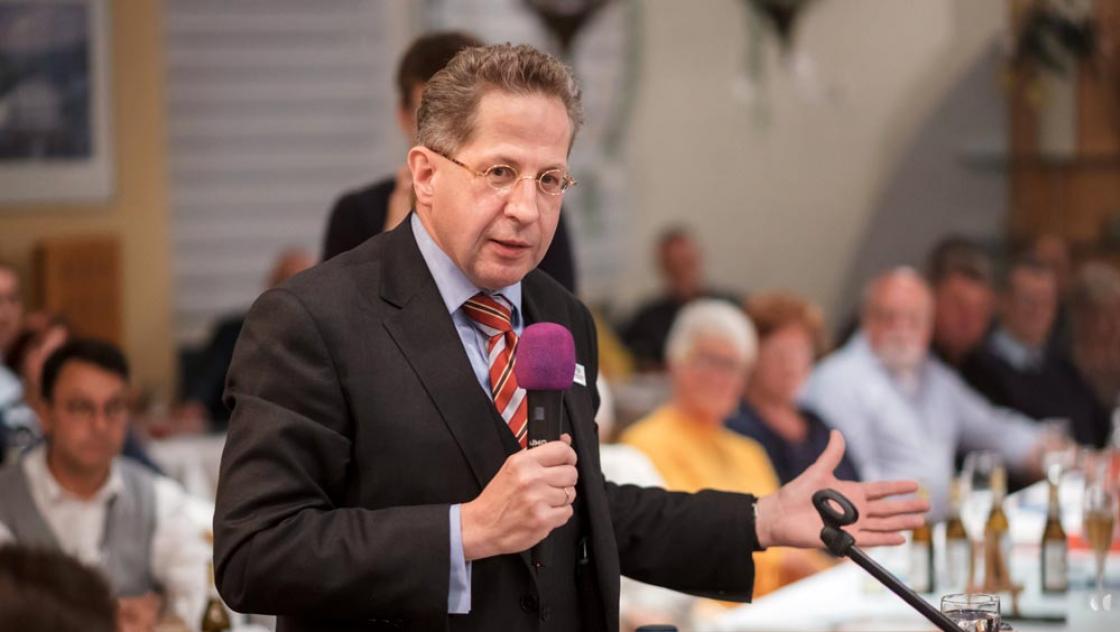
Bild: Der ehemalige Verfassungsschutzchef Hans-Georg Maaßen hält eine Wahlkampfrede in Suhl (Thüringen), 11.10.2019 (IMAGO / ari)
Nehmt den Wessis das Kommando“: Unter anderem mit diesem prägnanten Slogan bestreitet die Linkspartei derzeit ihren Wahlkampf in Sachsen-Anhalt. Zur Untermalung der Aussage ist auf dem Plakat ein rot gewandetes Kind zu sehen, das einen riesigen schwarz-weißen Hund an der Leine hält. Damit versucht Die Linke das in den letzten Jahren zum Teil von der AfD übernommene Terrain des Ost-West-Ressentiments zurückzuerobern und ihrerseits zu bewirtschaften.
Quelle: https://www.blaetter.de/ausgabe/2021/juni/merz-maassen-hoecke-der-osten-tickt-anders