Travelling During the COVID-19 Pandemic: The Erosion of Everyday Certainties
The social construction of reality (BERGER & LUCKMANN, 2007 [1969]) can be described on the basis of biographical experiences with the aid of autoethnographic texts (ELLIS, ADAMS & BOCHNER, 2010). Using biographical experiences with the aid of autoethnographic texts (ELLIS, ADAMS, & BOCHNER, 2010) I examine the effects of the COVID-19 pandemic on creating everyday certainties. In the first part of the article I describe a vacation trip I took to Egypt in March 2020. This trip had a significant impact on my assumptions regarding everyday certainties, as looming quarantine measures and closing borders turned the vacation into an adventure. This part of the article will be followed by a theoretical exploration of the experience according to SCHÜTZ and LUCKMANN (1979 [1975], 1984). I analyze the erosion of everyday certainties in a socio-phenomenological way in order to not only fathom the experience descriptively, but also to locate it sociologically in a theoretical manner.
Quelle: https://www.qualitative-research.net/index.php/fqs/article/view/3581
1871 und 1990: Die doppelte Einheit
1871 und 1990: Die doppelte Einheit
Blätter Verlag
18. Dezember 2020 - 18:02
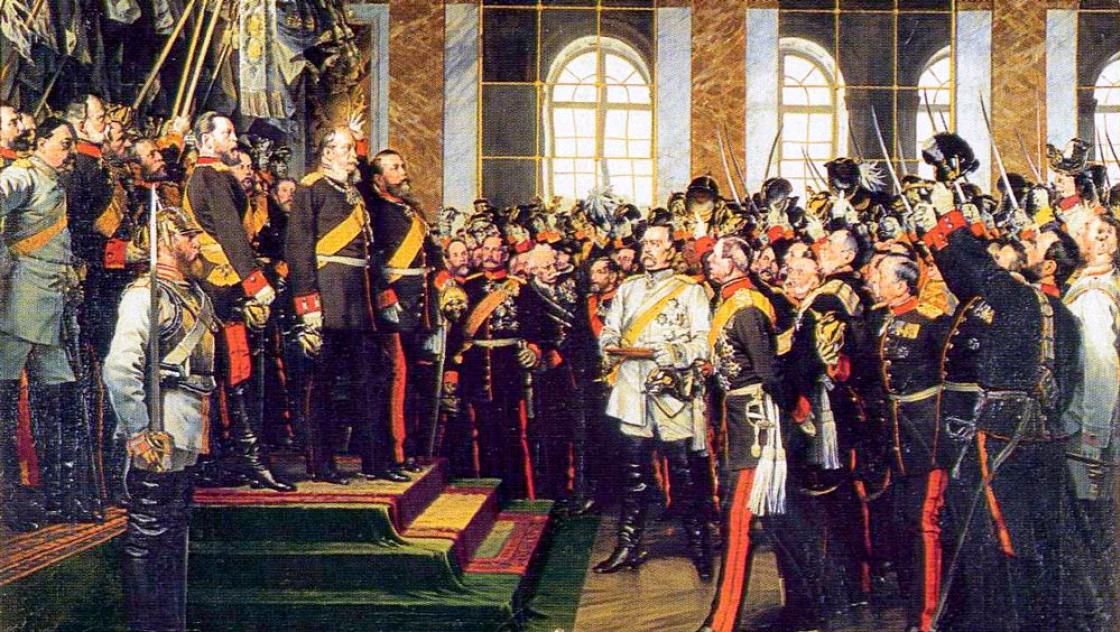
Bild: Kaiserproklamation Wilhelms I. in Versailles am 18. Januar 1871, von Anton von Werner (1885)
Am 18. Januar 1871 versammelten sich Vertreter des deutschen Militärs und Adels im Spiegelsaal des Versailler Schlosses, um Wilhelm I. zum Kaiser auszurufen und mit diesem Akt die erste staatliche Einheit Deutschlands symbolisch zu vollziehen. Ort und Zeit waren wohlüberlegt, denn just an diesem Tag im Jahre 1701 ließ sich Friedrich I. in Königsberg zum preußischen König krönen.
Quelle: https://www.blaetter.de/ausgabe/2021/januar/1871-und-1990-die-doppelte-einheit
Response by Odumosu to “Representing experiential knowledge”
Volume 14, Issue 1, January 2021, Page 108-113
.
.
Quelle: https://www.tandfonline.com/doi/full/10.1080/14781700.2020.1847181?ai=15d&mi=3fqos0&af=R
Editorial note
Volume 14, Issue 1, January 2021, Page 84-84
.
.
Quelle: https://www.tandfonline.com/doi/full/10.1080/14781700.2021.1863633?ai=15d&mi=3fqos0&af=R