Science for Competition among Powers: Geographical Knowledge, Colonial‐Diplomatic Networks, and the Scramble for Africa**
Abstract
Historical studies on the relationship between science and diplomacy tend to focus on events since World War II and on initiatives for the maintenance of peace or to achieve cooperation over contentious matters. This article presents the case of José Vicente Barbosa du Bocage (1823–1907), a Portuguese zoologist who had formal diplomatic responsibilities in a context of competition for the colonization of Africa in the nineteenth century. He used his knowledge in African geography to implement colonial and diplomatic strategies that aimed at outcompeting rival powers. The development of a network of actors with scientific, colonial, and diplomatic expertise was crucial for the negotiations that involved the partition of the Congo basin, which resulted in victories for Portugal that surpassed the country's marginal political relevance at the international level and had long‐lasting consequences.
Quelle: https://onlinelibrary.wiley.com/doi/abs/10.1002/bewi.202000016?af=R
For the Benefit of All Men: Oceanography and Franco‐American Scientific Diplomacy in the Cold War, 1958–1970**
Abstract
In the 1960s, the growing strategic importance of ocean exploration led the French government to develop greater capacity in marine scientific research, aiming to promote cooperative and diplomatic relations with the leading states in ocean exploration. Devised during Charles de Gaulle's government (1958–1969), the restructuring of French oceanography culminated, in 1967, in the establishment of the state‐led Centre National pour l'Exploitation des Océans (CNEXO). Beyond being intended to control the orientation of marine research at a national level, the CNEXO's mission was to use scientific diplomacy to balance a desire for enhancing international cooperative relations in oceanography with French ambitions to equal the USA's leading capacity to explore the oceans. Its director, the naval officer Yves la Prairie, played a crucial role in articulating scientific, national, and diplomatic interests for France in the oceans.
Quelle: https://onlinelibrary.wiley.com/doi/abs/10.1002/bewi.202000015?af=R
Numéro 2020/4 – n° 67-4 – Revue d’histoire moderne et contemporaine 2020-4
Page 7 à 30 : Antoine Perrier - Les archives d’un pacha. Conflits fonciers et expertise locale du gouverneur de Salé dans le Maroc colonial | Page 31 à 62 : Marie-Emmanuelle Chessel - La formation des dirigeants d’entreprise en question : la diffusion de la « méthode des cas » américaine (Lille, années 1950) | Page 63 à 93 : Claire-Lise Gaillard - Dans les coulisses d’une agence matrimoniale (Paris, 1842-1847) | Page 94 à 118 : Johanna Lehr - Les sociétés de pompes funèbres « israélites » à Paris sous l’Occupation à l’épreuve des persécutions allemandes et vichystes | Page 119 à 132 : Olivier Bouquet - La revanche de la mémoire en Turquie : qui est le “vrai Köprülü” ? | Page 133 à 145 : Arnaud Exbalin - La Nouvelle-Orléans reconnectée | Page 146 à 152 : Sarah Gensburger et Maël Le Noc - Un tournant spatial pour l’histoire de la Shoah en France ? | Page 153 à 154 : Olivier Charles - Jean Heuclin, Christophe Leduc (éd.), Chanoines et chanoinesses des anciens Pays-Bas. Le chapitre de Maubeuge du IXe au XVIIIe siècle, Villeneuve d’Ascq, Presses universitaires du Septentrion, 2019, 462 p., ISBN 978-2-7574-2949-5 | Page 154 à 156 : Noah Shusterman et Tomasz Doussot - Philippe Desmette, Philippe Martin (éd.), Orare aut laborare ? Fêtes de précepte et jours chômés du Moyen Âge au début du XIXe siècle, Villeneuve d’Ascq, Presses universitaires du Septentrion, 2017, 250 p., ISBN 978-2-7574-1725-6 | Page 156 à 158 : Matthieu Brejon de Lavergnée - Alison Forrestal, Vincent de Paul, the Lazarist Mission, and French Catholic Reform, Oxford, Oxford University Press, 2017, 312 p., ISBN 978-0-19-878576-7 | Page 158 à 160 : Géraldine Lavieille - Damien Tricoire, La Vierge et le Roi. Politique princière et imaginaire catholique dans l’Europe du XVIIe siècle, Paris, Presses universitaires de Paris-Sorbonne, 2017, 454 p., ISBN 978-2-84050-969-1 | Page 161 à 164 : Dominique Julia - Catherine Maire, L’Église dans l’État. Politique et religion dans la France des Lumières, Paris, Gallimard, 2019, 500 p., ISBN 978-2-07-285876-5 | Page 164 à 166 : Bruno Dumons - Denis Pelletier, Les Catholiques en France de 1789 à nos jours, Paris, Albin Michel, 2019, 349 p., ISBN 978-2-226-43933-8 | Page 166 à 168 : Hugh Mcleod et Christophe Duhamelle - Guillaume Cuchet, Faire de l’histoire religieuse dans une société sortie de la religion, Paris, Éditions de la Sorbonne, 2020, 298 p., ISBN 979-1-03-510520-4 | Page 168 à 170 : Clarisse Tesson - Anne Cova, Bruno Dumons (éd.), Femmes, genre et catholicisme. Nouvelles recherches, nouveaux objets, France, XIXe-XXe siècles, Lyon, Chrétiens et sociétés, 2012, 208 p., ISBN 978-2-9537928-9-8 | Page 170 à 172 : Carol E. Harrison - Caroline Muller, Au plus près des âmes et des corps. Une histoire intime des catholiques au XIXe siècle, Paris, Presses universitaires de France, 2019, 365 p., ISBN 978-2-13-080919-7 | Page 172 à 174 : Caroline Muller - Sylvie Steinberg (éd.), Une Histoire des sexualités, Paris, PUF, 2018, 520 p., ISBN 978-2-13-072979-2 | Page 175 à 176 : Marc André - Luc Capdevila, Femmes, armée et éducation dans la Guerre d’Algérie. L’expérience du service de formation des jeunes en Algérie, Rennes, Presses universitaires de Rennes, 2017, 234 p., ISBN 978-2-7535-5911-0 | Page 176 à 178 : Sylvie Thénault - Joshua Cole, Lethal Provocation. The Constantine Murders and the Politics of French Algeria, Ithaca, Cornell University Press, 2019, 317 p., ISBN 978-1-5017-3941-5 | Page 178 à 179 : Sébastien Farré - Yves Denéchère, Patrice Marcilloux (éd.), Le Centre international de l’enfance (1949-1997). Des archives à l’histoire, Rennes, Presses universitaires de Rennes, 2016, 204 p., ISBN 978-2-7535-4868-8 | Page 179 à 181 : Céline Pauthier - Marie-Luce Desgrandchamps, L’Humanitaire en guerre civile. La crise du Biafra, 1967-1970, Rennes, Presses universitaires de Rennes, 2018, 369 p., ISBN 978-2-7535-6513-5 | Page 181 à 183 : Christophe Blanquie - Fabrice Mauclair, La Justice des Lumières. Les tribunaux ordinaires en Touraine au XVIIIe siècle, Tours, Presses universitaires François Rabelais, 2019, 448 p., ISBN 978-2-86906-717-2 | Page 183 à 185 : Emmanuel Taïeb - Nicolas Picard, Le Châtiment suprême. L’application de la peine de mort en France, 1906-1981, Paris, Institut universitaire Varenne, 2018, 844 p. ISBN 978-2-37032-192-3 | Page 185 à 187 : Thomas Le Roux - Julia Moses, The First Modern Risk. Workplace Accidents and the Origins of European Social States, New York, Cambridge University Press, 2018, ISBN 978-1-108-42650-3 | Page 188 à 189 : François Chaubet - Mathieu Hauchecorne, La Gauche américaine en France. La réception de John Rawls et des théories de la justice, 1971-2010, Paris, CNRS Éditions, 2019, 335 p., ISBN 978-2-271-07543-7 | Page 189 à 192 : Ingrid Hayes - Michel Dreyfus, Michel Pigenet (éd.), La CGT en question(s). Regards croisés sur 125 années d’un syndicalisme de transformation sociale, Dijon, Éditions universitaires de Dijon, 2019, 172 p., ISBN 978-2-36441-309-2 | Page 193 à 194 : Clément Fabre - Georges Vigarello, Histoire de la fatigue. Du Moyen Âge à nos jours, Paris, Seuil, 2020, 480 p., ISBN 978-2-02-129191-9 | Page 195 à 196 : Philippe Poirrier - Françoise Taliano-Des Garets, Un Siècle d’histoire culturelle en France de 1914 à nos jours, Paris, Armand Colin, 2019, 430 p., ISBN 978-2-200-28663-7.
3. November 2020: Der Blick in den Abgrund
3. November 2020: Der Blick in den Abgrund
Blätter Verlag
25. November 2020 - 18:21

Bild: imago images / ZUMA Wire
Schon im Vorfeld des 3. November war klar, dass diese US-Wahl keine Wahl wie viele andere sein würde.[1] Doch die Ereignisse der Wahlnacht selbst wie auch der folgenden Tage haben sie endgültig zu einem existenziellen Vorgang für die Vereinigten Staaten, aber auch für die gesamte demokratische Welt gemacht. Diese Wahl wurde zu einem Exempel für die Angreifbarkeit und Verletzlichkeit der Demokratie.
Quelle: https://www.blaetter.de/ausgabe/2020/dezember/3-november-2020-der-blick-in-den-abgrund
Hauptfeind Iran: Israel und die neue sunnitische Achse
Hauptfeind Iran: Israel und die neue sunnitische Achse
Blätter Verlag
25. November 2020 - 18:20
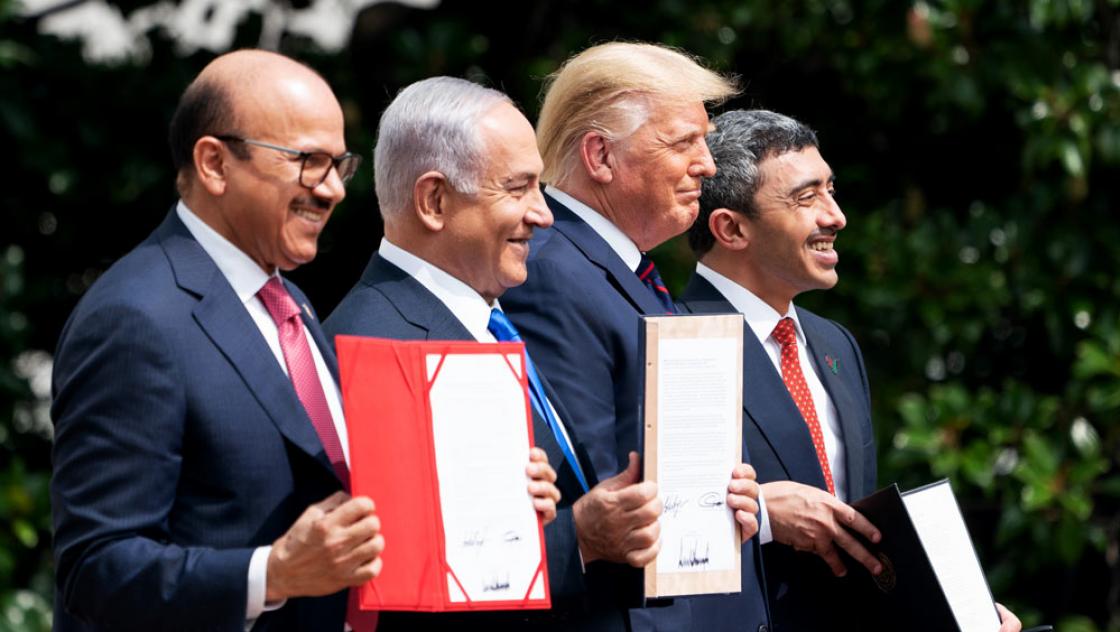
Der erste Flieger mit israelischen Touristen landete just an dem Tag in Dubai, an dem Joe Biden die letzten Wahlmännerstimmen zusammen hatte, um zum neuen amerikanischen Präsidenten gewählt zu werden. Drei Stunden dauerte der Flug der Boeing 737 des Billigfliegers FlyDubai vom Ben-Gurion-Flughafen in Tel Aviv über die arabische Halbinsel bis Dubai. Noch bis Jahresende will die Fluglinie eine regelmäßige Verbindung zwischen den Vereinigten Arabischen Emiraten (VAE) und Israel einrichten.
Quelle: https://www.blaetter.de/ausgabe/2020/dezember/hauptfeind-iran-israel-und-die-neue-sunnitische-achse
Kaczyńskis Kulturrevolution
Kaczyńskis Kulturrevolution
Blätter Verlag
25. November 2020 - 18:19
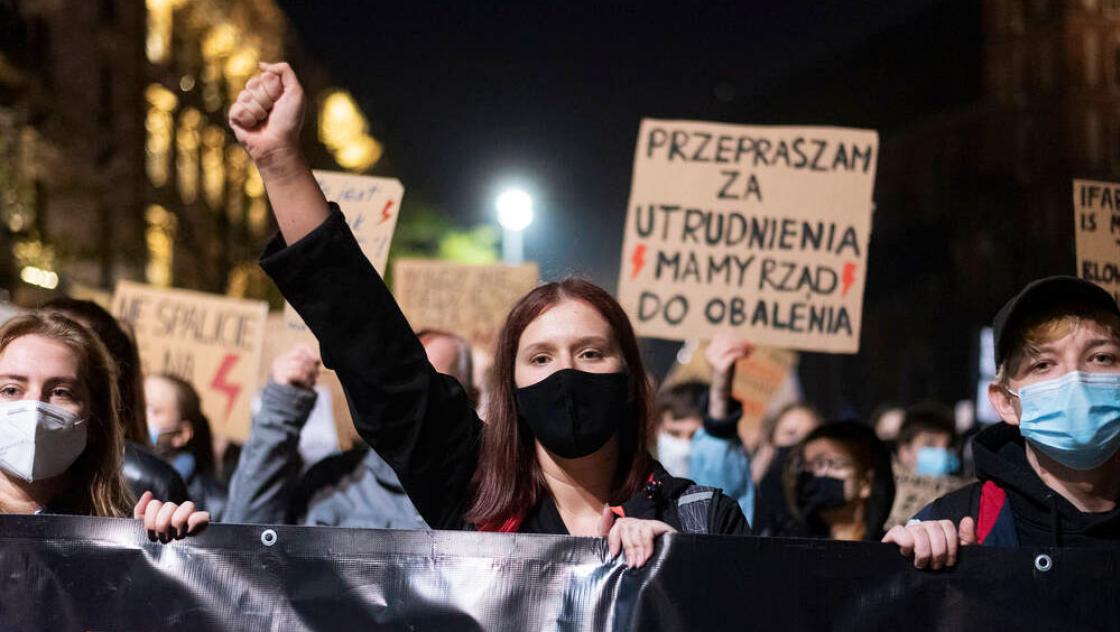
Bild: imago images / Hans Lucas
In Polen kündigt sich dieser Tage ein fundamentaler Kulturwandel an. Die gesellschaftliche Polarisierung erreicht mit dem „Frauenstreik“ gegen die Reform des Abtreibungsrechts einen neuen Höhepunkt. Seit langem ist die polnische Gesellschaft tief gespalten in proeuropäisch liberal-progressive und konservativ-nationale Kräfte. Medienpropaganda und Hetzkampagnen der Regierung schüren diese Polarisierung jeden Tag. Und die Bevölkerung ist zunehmend frustriert über die brüderliche Feindschaft im eigenen Land.
Quelle: https://www.blaetter.de/ausgabe/2020/dezember/kaczynskis-kulturrevolution
Landwirtschaft ohne Green Deal: Das Versagen der EU
Landwirtschaft ohne Green Deal: Das Versagen der EU
Blätter Verlag
25. November 2020 - 18:18
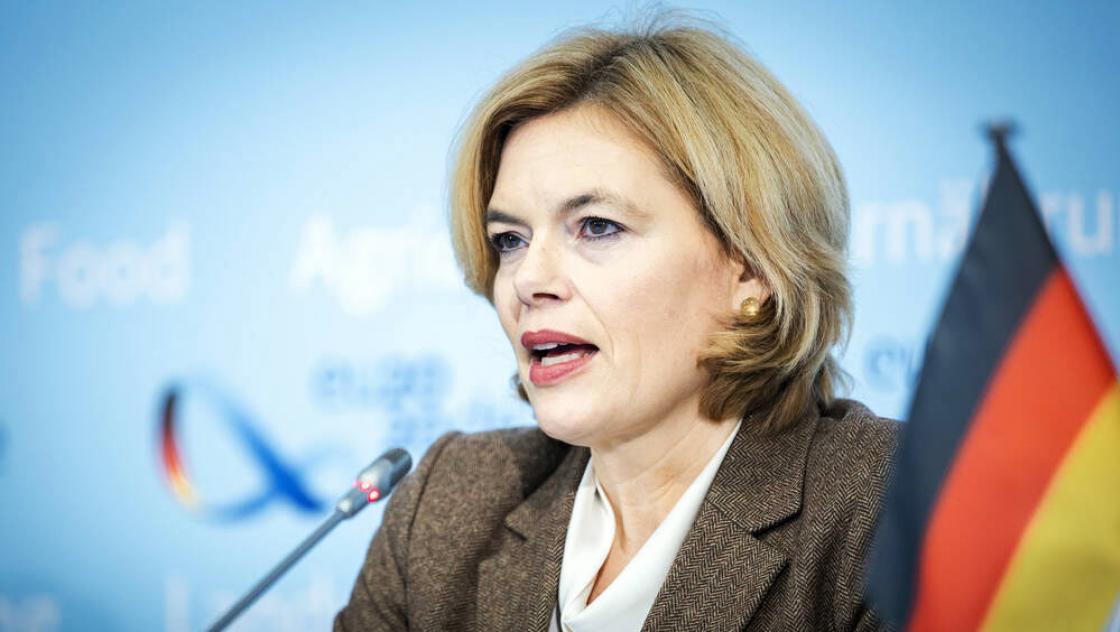
Bild: imago images / photothek
Kann man gleichzeitig vorwärts und rückwärts gehen? Kann man die Herausforderungen der Zukunft in den Blick nehmen, das Lenkrad zur Kehrtwende einschlagen – und gleichzeitig mit Vollgas geradeaus weiterfahren? Genau das macht gerade die Europäische Union.
Quelle: https://www.blaetter.de/ausgabe/2020/dezember/landwirtschaft-ohne-green-deal-das-versagen-der-eu