#linkhint pedocs. Open Access Erziehungswissenschaften / Fachausschnitt Historische Bildungsforschung
https://www.pedocs.de/lucene_ergebnis.php?la=de&suchart=teil&suchfeld1=class_dgfe&suchwert1=01 Der Dokumentenserver des Fachportals Pädagogik bietet einen Fachausschnitt zu ‘Historischer Bildungsforschung’. Die über 1.100 Einträge haben einen deutlichen Akzent auf die Neuzeit und umfassen überwiegend Zeitschriftenaufsätze, Sammelbandbeiträge und vereinzelt ganze Monographien. Das Nachweissystem bietet u.a. eine persistente Zitation mit URN, Verweise auf die Zeitschriftendatenbank sowie bei Personen Verlinkungen Gemeinsamen Normdatei der Deutschen Nationalbibliothek.
[...]
[...]
E-Learning 3.0. Präsentation des kanadischen Forschers Steven Downes zur ‘neuen Welle des Lernens’ (2018)
https://de.slideshare.net/Downes/elearning-30-119907672 Die Präsentation stellt entlang der Entwcklung des Web die methodischen Veränderungen eines mit Web 3.0 verknüpften E-Learning vor. Er geht hierbei insbesondere auf die Vernetzung von Daten und die damit einhergehenden Kompetenzänderungen ein.
Im Kern verbrecherisch – Kann man bei der Wehrmacht Leistungen würdigen?
Eine Forderung, die in rechten Kreisen periodisch immer wieder aufs Tablett kommt, ist, "Leistungen der Wehrmacht zu würdigen". Die dahintergehende Idee ist erst einmal eingängig. Zwar waren Wehrmachtssoldaten immer wieder in Kriegsverbrechen verstrickt, aber nicht jeder von ihnen. Deswegen müsse man trennen zwischen den Verbrechen von Wehrmachtssoldaten und der Wehrmacht als Institution. Die militärischen Leistungen letzterer, die unter Militärhistorikern in Grundzügen relativ unumstritten sind, könne man dann würdigen. Eine ähnliche Diskussion liegt den Traditionen der Bundeswehr zugrunde; zuletzt geriet sie im Zusammenhang mit einem Bild des jungen Leutnants Helmut Schmidt in die Kritik (hier im Blog thematisiert).
[...]
[...]
Quelle: http://geschichts-blog.blogspot.com/2019/09/im-kern-verbrecherisch-kann-man-bei-der.html
The Illuminati Correspondence Fast Forward
Paul-Olivier Dehaye scripted this visualisation for us – capturing the data of the Illuminati correspondence from the 1770s into the 1790s (there are some misfits in the visualisation which we can sudden spot and which need to be eliminated in the database, the visualisation is more of an aging screenshot of the database at the moment).
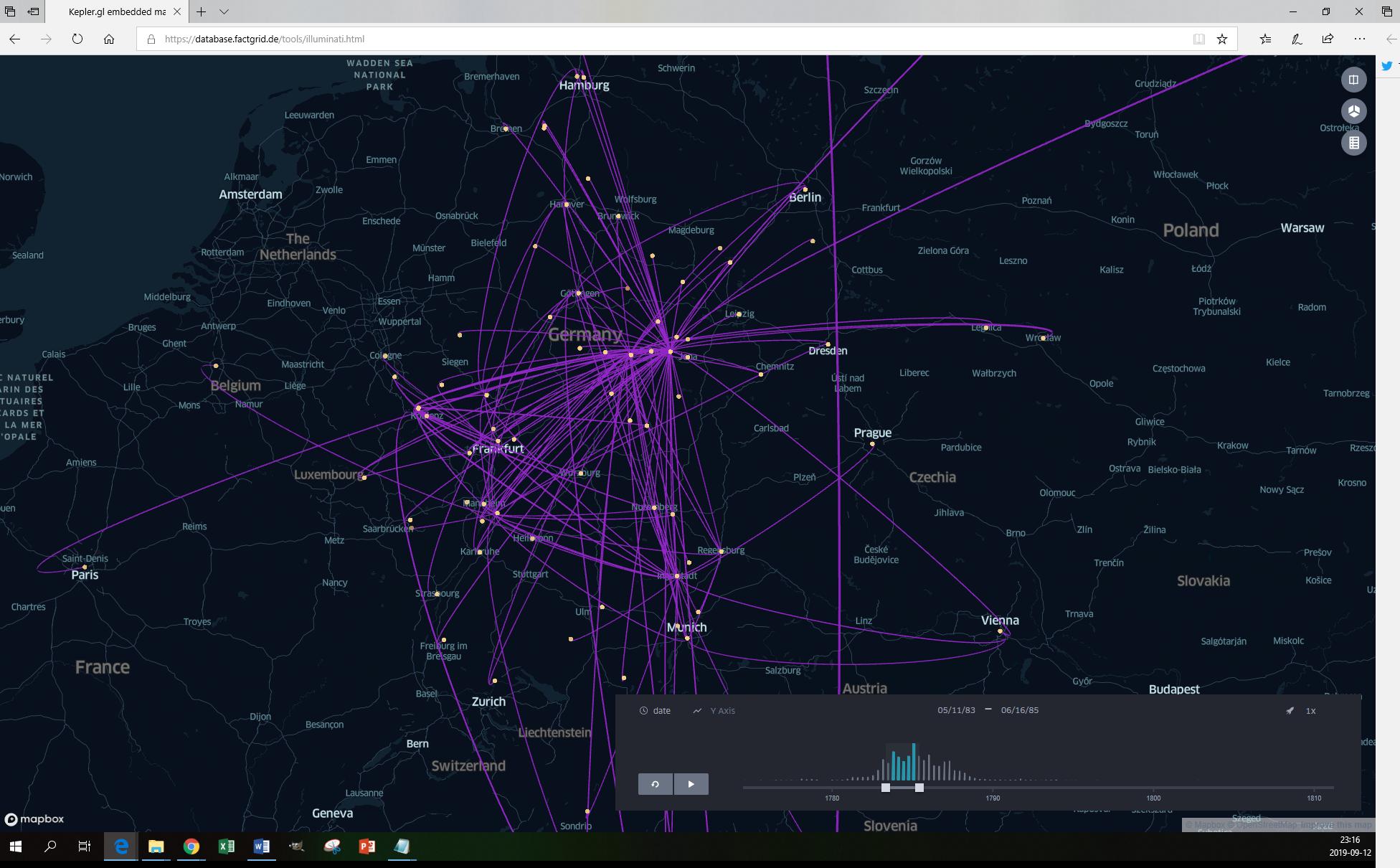
The idea to represent letters in lines on a map with a timeline on which the user can pick a segment that can then be shifted through the timeline – has become a classic over the last years: The Stanford Republic of Letters project seems to have been the first to come up with this visualisation ten years ago
Nodegoat is offering this kind of visualisation to anyone who opens an account with them.
The visualisation is cool for correspondences since letters happen to travel on maps from senders to recipients (or multiple recipients in case they are forwarded).
[...]
“Und der Zukunft zugewandt” (2019): Das Tabu Gulag
Ein Wendepunkt im DDR-Diskurs, hat ein Kollege über den Film „Und der Zukunft zugewandt&l...
Stellenausschreibung: Projektmitarbeiterin / Projektmitarbeiter (m/w/d), Entgeltgruppe 13 TV-L, Nr.: 2019/2 am Bibliotheksservice-Zentrum Baden-Württemberg (BSZ)
Das Bibliotheksservice-Zentrum Baden-Württemberg (BSZ), mit Sitz in Konstanz, sucht baldmöglichst für den Zeitraum von drei Jahren zum Aufbau einer Koordinierungsstelle zur bibliothekarischen Weiterbildung für Bibliothekspersonal an den Universitäten, Hochschulen und Landesbibliotheken Baden-Württemberg eine/n
Projektmitarbeiterin / Projektmitarbeiter (m/w/d)
(Entgeltgruppe 13 TV-L)
Das BSZ ist ein Daten-, Service- und Kompetenzzentrum des Landes Baden-Württemberg für Bibliotheken, Archive und Museen, welche das BSZ mit einer Vielzahl von Services und Angeboten unterstützt.
Mit der Koordinierungsstelle sollen die bisherigen Angebote für die bibliothekarische Fort- und Weiterbildung in Baden-Württemberg gebündelt werden und ein mit anderen deutschlandweiten Angeboten eng verzahntes Fortbildungsprogramm entwickelt werden.
Ihre Aufgaben
- Projektleitung für den Aufbau der Koordinierungsstelle
- Entwicklung eines attraktiven und innovativen Fortbildungsprogramms für wissenschaftliche Bibliotheken in Baden-Württemberg
- Aufbau der Infrastruktur: Außenauftritt und administrative Werkzeuge (CMS, CRM)
- Erstellung eines Businessplans
- Zusammenarbeit mit Projekt- und Kooperationspartnern sowie externen Dienstleistern
[...]
Quelle: https://dhd-blog.org/?p=12239
Stellenausschreibung: wissenschaftliche Mitarbeiterin / wissenschaftlicher Mitarbeiter als Softwareentwicklerin / Softwareentwickler an der Universitäts- und Landesbibliothek Münster
An der Universitäts- und Landesbibliothek Münster ist zum nächstmöglichen Zeitpunkt eine auf die Dauer von 4 Jahren befristete Stelle für
eine wissenschaftliche Mitarbeiterin / einen wissenschaftlichen Mitarbeiter
als Softwareentwicklerin / Softwareentwickler
zu besetzen.
Das an der Universitäts- und Landesbibliothek Münster (ULB Münster) angesiedelte Service Center Digital Humanities (SCDH) bietet ein breites Spektrum von Dienstleistungen im Kontext der Digital Humanities (DH) an. Dabei arbeitet es eng mit dem Center for Digital Humanities (CDH) und dem Exzellenzcluster 2060 „Religion und Politik. Dynamiken von Tradition und Innovation“ der Westfälischen Wilhelms-Universität Münster zusammen. Zu den Aufgaben des Service Centers gehören unter anderem die Beratung und Begleitung von DH-Projekten, die Bereitstellung standardisierter Werkzeuge, die Konzeption modellhafter Problemlösungen sowie die Unterstützung bei DH-Schulungen. Der Fokus der ausgeschriebenen Stelle liegt auf der Unterstützung der DH-Projekte des Exzellenzclusters Religion und Politik. Das Team des Service Center Digital Humanities freut sich in diesem Kontext auf Ihre Unterstützung!
[...]
Quelle: https://dhd-blog.org/?p=12237
Stellenausschreibung: Digital Scholarship Spezialist/in (80%-100%) befristet (je nach Anstellungsgrad) auf 2.5 Jahre an der Universitätsbibliothek Bern (UB)
- Wir stellen die Informationsmittel für Forschung, Lehre, Studium zur Verfügung – elektronisch oder auf Papier
- Wir helfen bei einfachen wie komplexen (Fach-)Recherchen und vermitteln Informationskompetenz
- Wir bieten Unterstützung und Infrastruktur für wissenschaftliche Publikationen, Forschungs- und Projektdaten
- Wir sammeln und digitalisieren Bernisches
- Und wir sind als Universitäts- und Kantonsbibliothek für alle da
Für das Team Digitale Dienste suchen wir ab sofort oder nach Vereinbarung eine engagierte und innovative Persönlichkeit für den Aufbau der neu zu gründenden Einheit für Digital Scholarship Dienstleistungen. Dies umfasst sowohl die organisatorische Verankerung als auch den Aufbau von Dienstleistungen.
In enger Zusammenarbeit mit Stakeholdern in der Universitätsbibliothek und auf dem Campus identifizieren Sie Anforderungen, entwickeln Konzepte für neue Dienstleistungen und implementieren diese. Sie verfügen über ein ausgeprägtes Interesse an digitalen Informationsdienstleistungen für eine wissenschaftliche Klientel.
[...]
Quelle: https://dhd-blog.org/?p=12235
Victor Klemperer: „Café Europe“, ein Kapitel aus dem LTI Notizbuch
In seiner kritischen Analyse der "Sprache des Dritten Reiches" setzt sich Victor Klemperer in Kap. 24 "Café Europe" mit dem Europabegriff auseinander.
Der Beitrag Victor Klemperer: „Café Europe“, ein Kapitel aus dem LTI Notizbuch erschien zuerst auf Wolfgang Schmale.
Quelle: https://wolfgangschmale.eu/klemperer-lti-cafe-europe/