Eigentlich war alles fertig vorbereitet: Die Truppen der Katholischen Liga waren marschbereit, die k...
Das fotografische Werk von Siegfried Wittenburg
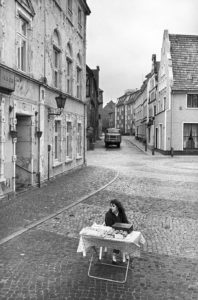
Quelle: https://visual-history.de/2025/08/14/das-fotografische-werk-von-siegfried-wittenburg/
Frauen mit gleichen Rechten? Ja, auch in der Kirche
Entwicklung, also Transformation hin zu humaneren, auch ökonomisch tragfähigeren (und, so ...
Demagogues, flateurs et adulateurs du peuple
Die Figur des Demagogen und der Verfassungswandel in Nicole Oresmes Livre de Politiques von Noah W...
2 neue DH-Projekte im DHd-Projekteschaufenster
Im DHd-Projekteschaufenster gibt es zwei neue DH-Projekte:
- „Jelinek online. Elfriede Jelinek: Werk und Rezeption“
- „Digitales Archiv der Bonner Längsschnittstudie des Alterns“
Informationen zu allen weiteren DH-Projekten im DHd-Projekteschaufenster gibt es hier:
http://dig-hum.de/forschung/projekte
Wenn Sie Ihr DH-Forschungsprojekt zum DHd-Projekteschaufenster hinzufügen möchten, dann senden Sie uns bitte eine kurze Projektbeschreibung zu. Weitere Informationen dazu finden Sie hier: http://dig-hum.de/ihr-dh-projekt
Herzlichen Dank.
[...]
Quelle: https://dhd-blog.org/?p=14029
Newsletter, Blogs, soziale Netzwerke – wo und worüber möchten Handschriften-Interessierte informiert werden?

Eine Umfrage des Handschriftenportals In welchen Netzwerken ist die mit Handschriften arbeitende Fac...
Son of Saul – Über die Macht der Sprache in Bild und Ton und dem Insistieren auf Menschlichkeit
Son of Saul (OT: Saul fia) ist ein ungarischer Spielfilm des Regisseurs und Autors Lászl&oacu...
Filling a Wikibase instance with Millions of Data
As more and more Wikibase instances are coming into existence we are seeing attempts to start them with masses of data from already existing data bases that switch to the new software.
Experimenting I tried to find a faster way to insert a huge amount of items into a Wikibase instance. I have not been able to insert more than two or three statements per second using the ‘official’ tools, such as QuickStatements or the WDI library.
Therefore, I am inserting the data directly into the MySQL database used by Wikibase.
The process consists of these steps:
- generate the data for an item in JSON
- determine the next Q number and update the JSON item data accordingly
[...]
#museumsreport Lascaux IV. Centre International d’Art Pariétal
Im Jahre 1940 wurde die jungpaläolithische Höhle von Lascaux entdeckt. Zum Schutz vor hohem Besucherandrang wurden Nachbildungen erstellt. Während Lascaux II und Lascaux III die Höhle nur in Teilen nachbildeten, präsentiert Lascaux IV Reproduktionen aller Kunstwerke und auch einiger kompletter Räume. Für den Laien und wohl auch den Experten ist ein Unterschied mit bloßem Auge nicht erkennbar. So bietet Lascaux IV dem Besucher eine Doppelsensation: die urgeschichtlichen Höhlenmalereien und ihre neuzeitliche Reproduktion. Der museumspädagogische Einsatz moderner Technologien ist behutsam genug, um das urgeschichtliche Flair nicht zu (zer)stören.
[...]
„We can´t breathe“: George Floyd und die Zukunft der USA
Der Mord an George Floyd löste weltweit Proteste aus, auch in Deutschland wie hier am Münc...