Antrittsvorlesung von Prof. Dr. Andreas Rutz an der TU Dresden, Dienstag, 5. November 2019, 18.30 Uh...
readme.txt: „Verfeindung und Verflechtung. Deutschland und Frankreich 1870-1918“
Lesen, Schreiben und Publizieren sind die Essenz von „Geisteswissenschaften als Beruf“. ...
Quelle: https://gab.hypotheses.org/6925
Der Theologe Werner Wick von Unshausen (gestorben 1510)
Oliver Auge hat den von Annelen Ottermann 2017 vermeldeten Fund einer verschollenen Handschrift der ...
4. November 1619: Vivat Fridericus, spes Bohemiae
Nur wenige Tage nach der Ankunft Friedrichs von der Pfalz in Prag wurde die Krönungszeremonie a...
Nur ein Wunschkonzert? Hinweis auf eine Twitterumfrage und ihre Auswertung
Die Historikerin Mareike König (DHI Paris) hat zur Vorbereitung eines Vortrags mit dem span...
Eine Sitzung der Gothaer Illuminaten von 1786 — rekonstruiert für die “Lange Nacht der Wissenschaften” der Uni Erfurt, 2019
Am 8. November 2019 inszenieren Mitarbeiter und Promovierende des Forschungszentrums Gotha anlässlich der Erfurter “Langen Nacht der Wissenschaften” 2019 eine Sitzung des Illuminatenordens aus dem Jahr 1786 – eine Zeitreise und ein Blick in den geheimnisumwobene Alltag des Ordens. Wenn die Illuminaten auch ein Geheimorden waren und wenn freimaurerische Sitzungen auch die Öffentlichkeit ausschließen, so sind wir im doch Rückblick ausnehmend gut in der Lage, zu erfassen, was in Sitzungen zumindest der letzten Ordensprovinz Ionien (Thüringen) in den 1780er Jahren geschah. Der Orden hatte eine ausgefeilte Bürokratie. Man protokollierte die Sitzungen. Die Rituale waren dabei an der Freimaurerei geschult, die man von zwei Seiten (mit der „Pflanzschule“ der „Minervalkirchen“ von unten und mit „Magistratssitzungen“ von oben) Loge nach Loge im deutschsprachigen Raum infiltrierte. Wir sind Stefan Sarrach von der Deutschen Mutterloge “Zu den Drei Weltkugeln” dankbar. Er warf mit uns einen Blick in die „Rituale“, die vorgaben, wie Sitzungen regulär zu gestalten waren. Die Bewegungen und Handlungsschritte blieben hier mit Wissen des Freimaurers zu erschließen.
[...]
Dem Flüchtigen nachgehen. Überlegungen zum Konzept der Erinnerungswege und zu Repräsentationsmöglichkeiten von Flucht
Ein Gastbeitrag von Anne Friedrichs und Bettina Severin-Barboutie Mehrsprachige Erinnerung in Portbo...
Nahaufnahme Wolfsburg 1962
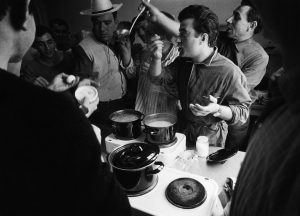
© bpk
Abb. 1: Gemeinsames Kochen und Essen, Wolfsburg 1962. Fotograf: Benno Wundshammer, Quelle: reportagefotografie © bpk-bildagentur mit freundlicher Genehmigung
Violetta Rudolf im Interview mit Alexander Kraus
Alexander Kraus: Wie kommt es, dass die Redaktion der „Quick“, damals eine der auflagenstärksten deutschsprachigen Illustrierten, ihren Fotojournalisten Benno Wundshammer im Frühjahr 1962, nur wenige Wochen nachdem die ersten italienischen Arbeitsmigranten ihre Arbeit bei der Volkswagenwerk AG aufgenommen hatten, nach Wolfsburg schickten, um eine Reportage über diese zu erarbeiten? War das Thema als solches so kurios, die Neugierde des Lesepublikums so groß?
Violetta Rudolf: Es war weniger die Kuriosität des Themas als vielmehr die Aktualität und die überregionale Bedeutung, die es interessant machten: Die italienischen Arbeitsmigranten, die seit Januar 1962 nach Wolfsburg kamen, waren Teil einer großen Migrationsbewegung, die sich seit Mitte der 1950er Jahre durch die Anwerbung sogenannter Gastarbeiter in Bewegung gesetzt hatte.
[...]
Quelle: https://www.visual-history.de/2019/11/04/nahaufnahme-wolfsburg-1962/
Stellenausschreibung: Informatiker*in digitale Langzeitarchivierung, 60-100%, Baden
Die Open-Source-Lösung docuteam cosmos für digitale Archivierung ist einzigartig. In der Cloud ermöglicht sie die Nutzbarhaltung von Daten über Jahrzehnte. Unser Informatikteam braucht Sie als Verstärkung für den Betrieb, Unterhalt und Weiterausbau dieser innovativen und zunehmend nachgefragten Plattform. Mit der zunehmenden Automatisierung von Daten-management und Infrastruktur machen wir sie noch performanter.
Ihre Kompetenzen
- Fundierte Ausbildung (FH, Uni, ETH, etc.)
- Vertrauter Umgang mit Serverdiensten primär auf Linux, aber auch Windows (Applikationsserver, Datenbanken, Verzeichnisdienste, Webserver)
- Erfahrung in der Überwachung von Serverumgebungen
- Routinierter und kreativer Umgang mit Skriptsprachen und Automatisierungswerkzeugen
[...]
Quelle: https://dhd-blog.org/?p=12446
Von wegen Konvent?
 Einem Scherz zufolge können Historiker*innen im Gegensatz zu Gott auch die Vergangenheit verändern. Wenn Jesse Spohnholz mit seiner Geschichte des “Konvents von Wesel” 1568 Recht hat, werden die Möglichkeiten der Zunft sogar noch stark unterschätzt: Wer sich seine Vergangenheit erfindet, bildet Traditionen und damit Möglichkeiten, die eine langfristige Wirkung entfalten – im Falle der niederländischen Nationalkirche und des “Konvents von Wesel” bis heute.
Die Fragen von Wirkung und Vergangenheitsbildung, die Konfessionsbildung am Niederrhein und in den Niederlanden sowie nicht zuletzt die Geschichte des “Konvents von Wesel” untersucht – besser: hinterfragt – der amerikanische Historiker Jesse Spohnholz (Washington State University) in seinem jüngsten Buch von 2017. Die hier folgende Vorstellung des Bandes gibt nicht nur den eigenen Leseeindruck wieder, sondern greift auch Punkte von David Luebke (University of Oregon), Ute Lotz-Heumann (University of Arizona) und Yair Mintzker (Princeton University) beim Round Table auf der German Studies Association Conference am 4. Oktober 2019 in Portland (Oregon, USA) auf.
Aus Wesel nichts Neues? – Was der “Konvent von Wesel” sein sollte
[...]
Quelle: http://histrhen.landesgeschichte.eu/2019/11/rezension-konvent-von-wesel/