Im Sommer 1619 war auch reichspolitisch ein Ereignis angesetzt, das von immenser Bedeutung für ...
Journalismus, der die Welt verändert
Ein Blick von außen auf unsere Experten-Anhörung: Silvia Godano war am 2. Juli im Hö...
Sachsen: Orientierungsnotstand
Ein Buch zu den Herbstwahlen 2019. Ein Buch zur Lage im Osten und zur Geschichte dieses Landes. Ein ...
Das Virtuelle Migrationsmuseum des DOMiD
© ViMu
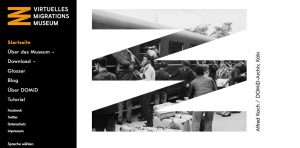
Screenshot der Startseite: Virtuelles Migrationsmuseum DOMiD ©
Das Dokumentationszentrum und Museum über die Migration in Deutschland (DOMiD) ist ein Kölner Verein, der sich die Dokumentation der Migration nach Deutschland zur Aufgabe gemacht hat. 1990 als „Archiv von unten“ von aus der Türkei stammenden Migranten unter dem Kürzel DOMiT (Dokumentationszentrum und Museum über die Migration aus der Türkei e.V.) gegründet, widmete es sich zunächst ausschließlich der Migrationsgeschichte aus der Türkei. 2007 erfolgte die Fusion mit dem Verein Migrationsmuseum in Deutschland und die thematische Weitung hin zur Geschichte der Einwanderung nach Deutschland in allen Facetten.
Das langfristige Ziel der Mitarbeiterinnen und Mitarbeiter ist die Errichtung eines zentralen Migrationsmuseums in Deutschland. Als ein wichtiger Schritt auf diesem langwierigen Weg ist im Sommer 2018 das Virtuelle Migrationsmuseum (ViMu) entstanden. In diesem frei downloadbaren Programm bewegen sich die Nutzenden in einer digitalen fiktiven Stadt der Migrationsgesellschaft.
[...]
Quelle: https://www.visual-history.de/2019/07/08/das-virtuelle-migrationsmuseum-domid/
Little Green Men im Sudetenland
In Bezug auf die Ukrainekrise und auch die russischen Drohgebärden in Richtung der baltischen Staaten taucht immer wieder die Beschwörung der Gefahr mindestens eines neuen Kalten Kriegs, möglicherweise aber auch eines zu einem echten, heißen Kriegs eskalierenden Zwischenfalls zwischen den EU/NATO-Staaten auf der einen und Russland auf der anderen Seite auf. In einem Zeitalter, das den dreißigsten Jahrestag des Mauerfalls zu begehen gedenkt und dessen Armee mittlerweile eher die Stabilisierung von failed states fern der Heimat denn die Verteidigung selbiger Heimat gegen einen Panzervorstoß durch die norddeutsche Tiefebene zu ihren Pflichten zählt, scheint diese Gefahr nicht wirklich vorstellbar zu sein. Wie ein solcher Konflikt aber tatsächlich zu einer dramatischen Krise werden kann, zeigt uns ein Blick in die Geschichte des Jahrs 1938 - und nein, wir reden nicht vom Appeasement im September. Wir reden von dem, was davor kam.
[...]
[...]
Quelle: http://geschichts-blog.blogspot.com/2019/07/little-green-men-im-sudetenland.html
Das Fräulein-Problem
Neue koreanische Faust-Übersetzung erschienen „Mein schönes Fräulein, darf...
Collaborating on the sum of all knowledge across languages
[The following article is from the Wikipedia @ 20 blog and extremely interesting to have here as well. The present copy is a draft version and offered on the original page together with the invitation to propose improvements. Denny Vrandečić (actually Zdenko) is working at Google. Previously he has been at the Institute AIFB at the KIT (Karlsruhe Institue of Technology) and at Wikimedia Deutschland, where he founded Wikidata.]
Wikipedia is available in almost 300 languages, each with independently developed content and perspectives. Sharing more knowledge across languages would allow each edition to focus on their unique contributions, and yet improve their comprehensiveness and currency.
Differences between Wikipedia language editions
Wikipedia is often described as a wonder of the modern age. There are more than 50 million articles in almost 300 languages.
[...]
Was machst du denn da, wenn du bloggst?
Im hypotheses-Redaktionsblog hat Mareike König Resultate einer Umfrage zum akademischen Bloggen...
Von Dänemark lernen?
Seit Ende Juni hat Dänemark wieder eine sozialdemokratische Regierung. Wie es der dänische...
Leitung der Bereiche Technik, Entwicklung und Service der Deutschen Digitalen Bibliothek (m/w/d)
Die Deutsche Nationalbibliothek sucht am Standort Frankfurt am Main zum nächstmöglichen Zeitpunkt eine
Leitung der Bereiche Technik, Entwicklung und Service der Deutschen Digitalen Bibliothek (m/w/d)
Die Deutsche Digitale Bibliothek (DDB) schafft über das Internet freien Zugang zum kulturellen und wissenschaftlichen Erbe. Sie macht die Bestände der deutschen Kultur- und Wissenseinrichtungen kostenfrei online zugänglich. Dafür werden die digitalen Angebote von Museen, Bibliotheken, Archiven, Forschungsinstituten, Mediatheken, Denkmalpflegeeinrichtungen und Bildarchiven vernetzt. Millionen von Büchern, Archivalien, Bildern, Skulpturen, Musikstücken und anderen Tondokumenten, Filmen und Noten sind so über ein zentrales Portal auffindbar. Die DDB ist auch der Beitrag der Bundesrepublik Deutschland zur europäischen digitalen Plattform Europeana. Sie verteilt sich auf verschiedene Standorte, darunter Frankfurt am Main mit der Zuständigkeit für die Bereiche Technik, Entwickung und Service bei der Deutschen Nationalbibliothek.
Den vollständigen Text der Stellenausschreibung finden Sie auf unserer Homepage unter https://www.dnb.
[...]
Quelle: https://dhd-blog.org/?p=12029