Neue Vortragsreihe: DOING DH
Der Arbeitskreis Digital Humanities der Universität Münster startet im Wintersemester seine neue Vortragsreihe „DOING DH“ – und alle Interessierten sind herzlich eingeladen! Wir freuen uns, für das Semesterthema „Kulturgut im digitalen Wandel“ ein spannendes Programm mit Münsteraner und externen Referent:innen anbieten zu können. Los geht es bereits am 20. Oktober 2026 mit einem Vortrag von Viola Voß (ULB Münster) zum Thema „Wissenschaftliche Literatur im Open Access. Was, warum, und wie?“
Mit wechselnden Semesterschwerpunkten lädt das Format herzlich all diejenigen ein, die bislang noch wenig Erfahrung mit DH-Methoden haben oder sich in spezifische Themen vertiefen möchten. Die Veranstaltungsreihe findet in Präsenz statt – auf Anfrage ist eine Teilnahme per Zoom möglich.
Mehr Informationen gibt es hier: https://uni.
[...]
Quelle: https://dhd-blog.org/?p=24360
Ringvorlesung „Digital Humanities im Fokus“
Im Wintersemester 2026/27 wird die Ringvorlesung „Digital Humanities im Fokus: Methoden, Anwendungen und Perspektiven“ an der Universität Rostock fortgesetzt. Die Veranstaltung wird von der Professur für Digital Humanities in Kooperation mit dem Rostocker Arbeitskreis Digital Humanities (RosDH) organisiert.
Die Vorträge finden im hybriden Format statt. Eine vorherige Anmeldung für die einzelnen Termine ist nicht erforderlich.
Programm für das Wintersemester 2026
02.11.2026
Dr. Katja Politt (Rostock / Bielefeld)
HDGDL dein ALLER größter Fan JoSiE – Korpuslinguistische Zugänge zu Intensivierung in YouTube-Kommentaren
[...]
Quelle: https://dhd-blog.org/?p=24285
Women Playwrights in Digital Corpora: a DraCor Hackathon
Literary historians maintain that women have never contributed significantly to the German drama. Facts, however, point clearly to the opposite. Indeed, the first known German dramatist (10th century) was a woman! Two major causes for the lack of historic recognition are: (a) prejudice that women are incapable of good dramatic production, (b) underrating of plays because professional critics—traditionally men—have used male psychology as the criterion for judging female characters in plays by women. A revaluation of women’s contributions to drama is imperative.
(Scholtz Novak 1972, 47)
When the German-born American scholar of German literature Sigrid Scholtz Novak issued her call for greater recognition of women playwrights in the early 1970s, she was responding to a literary historiography that had either largely overlooked women’s extensive dramatic production or fundamentally questioned its aesthetic and historical significance. More than five decades later, scholarly engagement with women playwrights has expanded considerably. Nevertheless, the problem of accessibility identified by Scholtz Novak remains unresolved. Many plays by women are still available only in historical print editions, are dispersed across libraries and archives, or are absent from the digital text collections that increasingly underpin literary-historical scholarship and computational research.
[...]
Quelle: https://dhd-blog.org/?p=23996
Lecture: Tackling Data Gaps in Digital Humanities, 09.09.26, online
We invite you to the online lecture by Dr. Sarah Lang (Max Planck Institute for the History of Science) on 09.09.2026 from 10:00 to 11:30, organised as a part of the seminar series ‘Legal History Meets Digital Humanities’ at the Max Planck Institute for Legal History and Legal Theory.
Digital humanities (DH) has long presented itself as a field committed to openness, collaboration, and innovation. Yet, alongside its many achievements, it also exhibits a number of persistent „dark sides“, ranging from infrastructural inequalities and invisible forms of labour to exclusionary data practices and the reproduction of historical and contemporary biases through digital methods. This chapter argues that one of the most pressing challenges currently facing the field is the persistence of data gaps, understood not merely as missing information but as the result of social, historical, and technical processes that systematically privilege some forms of knowledge while marginalising others. Building on work in critical digital humanities, critical archival studies, critical data studies, critical code studies, and feminist scholarship (including feminist AI ethics), the chapter examines how these traditions have conceptualised and addressed such absences, and considers how their insights can be mobilised more systematically within DH research and practice. It further situates these discussions within the recent shift towards data-centric approaches in artificial intelligence (DCAI), where the quality, documentation, and representativeness of datasets have become central ethical and technical concerns.
[...]
Quelle: https://dhd-blog.org/?p=23983
KI als Belastungsprobe für das offene Internet? Bericht vom Panel bei der DHd 2026 in Wien
Autor*innen (in alphabetischer Reihenfolge): David Maus, Staats- und Universitätsbibliothek Hamburg, https://orcid.org/0000-0001-9292-5673; Sarah Oberbichler, Luxembourg Centre for Contemporary and Digital History (C²DH), https://orcid.org/0000-0002-1031-2759 ; Grischka Petri, FIZ Karlsruhe – Leibniz-Institut für Informationsinfrastruktur ,https://orcid.org/0000-0002-2548-449X; Cindarella Petz, Leibniz-Institut für Europäische Geschichte (IEG) Mainz, https://orcid.org/0000-0002-6178-7332 ; Klaus Rettinghaus, Sächsische Landesbibliothek — Staats- und Universitätsbibliothek Dresden (SLUB), https://orcid.org/0000-0003-1898-2543; Ulrike Wuttke, Fachhochschule Potsdam. Fachbereich Informationswissenschaften, SeDOA, https://orcid.org/0000-0002-8217-4025
Hintergrund des Panels auf der DHd 2026
Am 25. Februar 2026 fand bei der DHd 2026 in Wien das Panel “KI als Belastungsprobe für das offene Internet” (Link zum Abstract auf Zenodo: https://doi.
[...]
Quelle: https://dhd-blog.org/?p=23949
Virtuelles DH-Kolloquium an der BBAW, 29.06.2026: „Was ist das für 1 struggle ey 🙈“ – Autorenerkennung im Instant Messaging
Im Rahmen des DH-Kolloquiums an der BBAW laden wir Sie herzlich zum nächsten Termin am Montag, den 29. Juni 2026, 16 Uhr c.t., ein (virtueller Raum: https://meet.academiccloud.de/gl/lou-eyn-nm6-t6b):
Gaby Axer (Universität Mannheim)
über
„Was ist das für 1 struggle ey  “ – Autorenerkennung im Instant Messaging
***
Die Forensische Linguistik im engeren Verständnis befasst sich mit der Frage der Autorschaft eines Textes und konzentriert sich dabei auf zwei Hauptfragen:
- Was kann ich über den Autor eines anonymen Textes anhand der sprachlichen Merkmale ableiten?
[...]
Quelle: https://dhd-blog.org/?p=23889
DH-Tag 2026 der Universität Münster – Programm online!
Der diesjährige DH-Tag der Universität Münster steht vor der Tür. Am 10. Juli 2026 wartet ein abwechslungsreiches Format zum Thema „Digital Humanities: Human Autonomy?“ auf Sie – das offizielle Programm ist nun online.
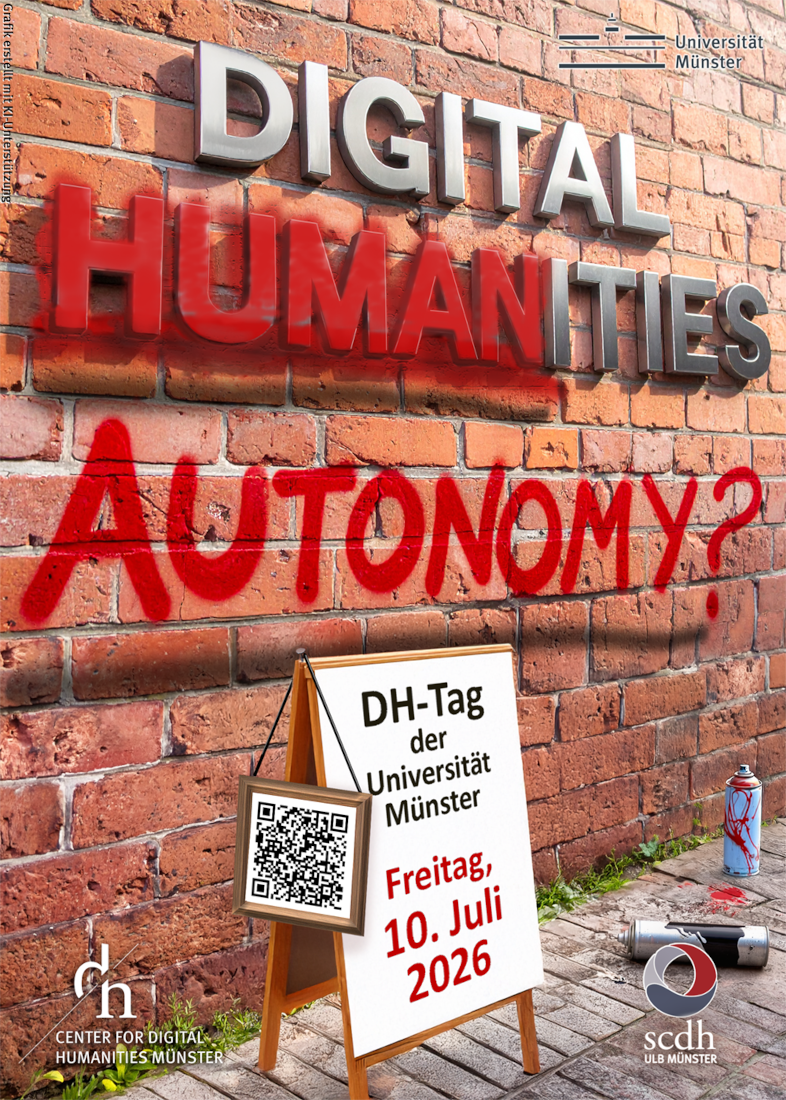
Ganz besonders freuen wir uns, mit Prof. Dr. Tobias Hodel von der Universität Bern einen ausgewiesenen Experten auf dem Gebiet KI-gestützter Arbeitsweisen als Keynote Speaker gewonnen zu haben.
[...]
Quelle: https://dhd-blog.org/?p=23811
Einladung zum morgigen Online-Vortrag von Zita Baronnet im Rahmen des TCDH-Forschungskolloquiums
Gerne möchten wir Sie zum morgigen Online-Vortrag (16–18 Uhr (c.t.)) im Rahmen des TCDH-Forschungskolloquiums einladen:
Zita Baronnet (Universität Trier / TCDH): „Urheberrechtlich geschützte Texte online veröffentlichen: Ein Versuch, das Paradoxon zu lösen”
Wie kann man urheberrechtlich geschützte Texte online zugänglich machen, ohne gegen das Urheberrecht zu verstoßen? Wenn urheberrechtlich geschützte Texte als Klartext online verbreitet werden, wird das Urheberrecht verletzt. Andererseits sind komplett verschlüsselte Texte nutzlos für Forscher, da keine computergestützten Analysemethoden wie Sentiment Analysis auf ihnen verwendet werden können. Ziel des DFG-Projekts ‚Forschen mit Derivaten‘ – das im Vortrag vorgestellt wird – ist die Entwicklung eines Ansatzes, mit dem urheberrechtlich geschützte Texte online veröffentlicht und trotzdem analysiert werden können, ohne das Urheberrecht zu verletzen. Wir untersuchen verschiedene Methoden, von der Randomisierung bis zur homomorphen Verschlüsselung, um dieses Problem zu lösen.
[...]
Quelle: https://dhd-blog.org/?p=23804
Virtuelles DH-Kolloquium an der BBAW, 18.05.2026: Introducing Playfair: An Integrated Scholarship Environment
Im Rahmen des DH-Kolloquiums an der BBAW laden wir Sie herzlich zum nächsten Termin am Montag, den 18. Mai 2026, 16 Uhr c.t., ein (virtueller Raum: https://meet.academiccloud.de/gl/rooms/lou-eyn-nm6-t6b/join)
Dr. Jeffrey Wolf (Vrije Universiteit Brussel)
Humanities researchers today work across a fragmented landscape of digital tools. Citation managers know nothing about manuscript images.
[...]
Quelle: https://dhd-blog.org/?p=23784
Lecture: Embedding the Past: From Visual Artefact to Semantic Data – AI-Supported Workflows in Digital Scholarly Editing, 22.05.2026, online
We invite you to the online lecture by Prof. Dr. Michael Schonhardt (TU Darmstadt) on 22.05.2026 from 10:00 to 11:30, organised as a part of the seminar series ‘Legal History Meets Digital Humanities’ at the Max Planck Institute for Legal History and Legal Theory.
The presentation will focus on the AI-driven datafication of historical sources, ranging from medieval manuscripts to early modern correspondence, into structured and semantic data. It will explain the Digital Editing Toolkit, a modular AI-based editorial workflow, and discuss the potential of vector embeddings and entity linking for new heuristic approaches to digitised source corpora. Finally, it will evaluate how these methods reshape the role of the editor in the age of large-scale datafication
Registration and more information here: https://plan.
[...]
Quelle: https://dhd-blog.org/?p=23735